
今シーズンは山間部でガイドする機会が増えました。
温暖な冬の影響か、ハンノキの雄花が豊作なのが理由か、平野部のエゾモモンガの出巣が遅くなったのが1月中旬頃。30以上はある巣穴をガイド仲間と協力して常にチェックしていますが、良い巣穴が見つかりません。といっても今までが良すぎてガイドの基準が上がっているのも理由なのですが・・・。やっぱり一番の原因は気温だと思います。今年の冬の動物たちは、なんとなく冬を生き抜く事に切迫したものが無いようで、のんびりしているように感じます。餌は豊富にあり、寒さで凍える心配もない。それならリスクの高い明るい時間に出て必死にエネルギーを摂る必要のない。
まるでそれを裏付けるかのように、山間部のエゾモモンガは出巣が早くなりました。
面白いのが山へ頻繁に行くようになり、新しい発見がいくつもあったこと。毎日通うと見えなかったものが見えるようになる不思議。とにかく、繰り返しゆっくり歩くことが大事です。
This season, I’ve found myself spending much more time guiding in the mountain areas.
Whether it’s due to the unusually mild winter or perhaps the bumper crop of male alder catkins, the Siberian flying squirrels (Ezo Momonga) in the lowlands started leaving their nests later than usual—around mid-January. My fellow guides and I have been keeping a close eye on over thirty known nesting holes, but finding a “perfect” one has been a challenge. To be fair, we’ve been spoiled by such great sightings in the past that our standards might be getting a bit too high…
However, I believe the real reason is the temperature. This winter, the animals seem to lack that usual “edge” needed to survive the cold. They appear quite relaxed. With food in abundance and no immediate threat of freezing, there’s simply no need for them to take the risk of heading out during the bright daylight hours to frantically forage for energy.
Almost as if to prove this point, the flying squirrels in the mountains have actually started emerging earlier. It’s been fascinating to head into the mountains more frequently; I’ve made several new discoveries. It’s the strange magic of nature: when you visit every day, things that were once invisible suddenly become clear.
Above all, the most important thing is to walk slowly, and to do it repeatedly.
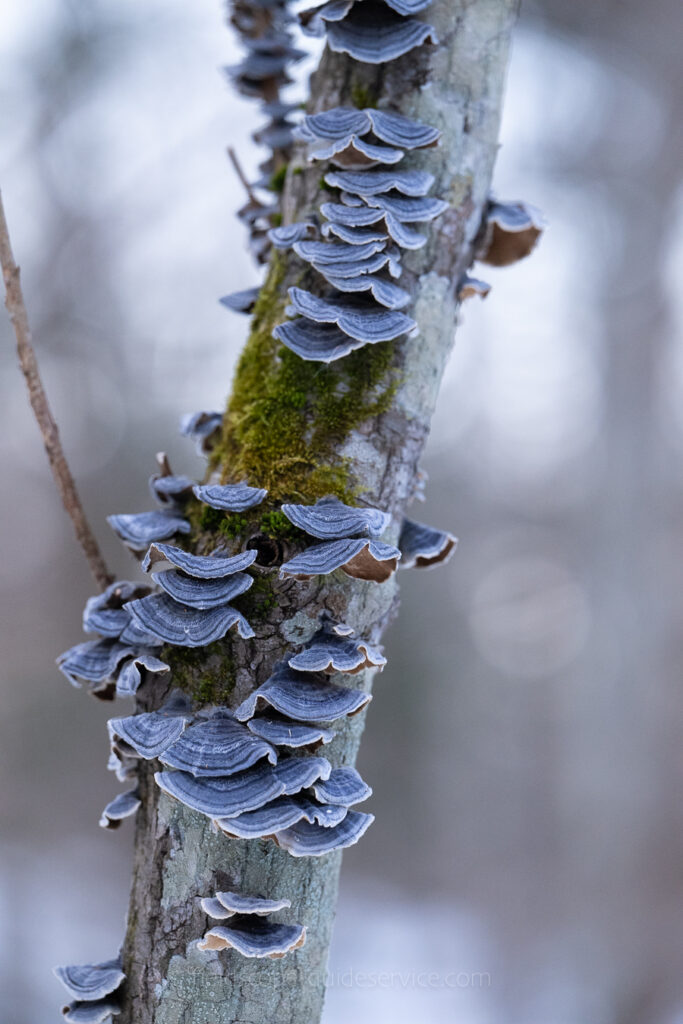
良く考えるのですが、本質はあまり目立たず、地味で見つかりづらいようになっているな。ということです。
時代やテクノロジーによって左右されない不変的なもので、ある種の真理、なのかな?
自然の価値に少しでも気がついてくれる人が増えるといいなと思います。
I often find myself reflecting on this: essence, by its very nature, tends to be inconspicuous. It is modest, quiet, and not easily found.
Perhaps it is a kind of universal truth—something immutable, untouched by the shifting tides of time or technology.
My hope is that, bit by bit, more people will begin to notice these quiet values hidden within the natural world.
新しいクマゲラのねぐらを見つけた日も、地味な1日でした。午前中は特に何も出会うことなく、時間が経って固くなった自家製食パンとスープで休憩して、少し長く森を歩きたいと思いスノーシューを履きました。電波の無い雪の森を、気持ちよく歩いていると突然目の前を横切るクマゲラに遭遇しました。森の木々から漏れる午後の光が粉雪に当たると光線なって浮かび上がります。なんとも言えない空気が包み、ケーンケーンというクマゲラの鳴き声だけが響きました。ここに来る前にランチを食べていなかったら、歩くエリアが違っていたら、今日リサーチをしていなかったら、もっというとガイドになっていなかったら・・・出会えなかったクマゲラだなぁなんてことを考えていると、クマゲラは森の南側から北側へと飛んでいき、樹皮の剥がれたトド松のあたりで、ふっと消えてしまいました。
Even the day I found the new Black Woodpecker’s roost began as a rather unremarkable one.
The morning passed without any particular encounters. I took a break with some homemade bread—a bit tough from the passage of time—and a bowl of soup. Feeling like a longer trek, I strapped on my snowshoes. As I was enjoying a peaceful walk through the snow-covered forest, far beyond the reach of any cell service, a Black Woodpecker suddenly swept across my path.
The afternoon light, filtering through the trees, hit the powdered snow and turned into beams of radiance. A strange, indescribable atmosphere filled the air, with nothing but the bird’s sharp “kyoon-kyoon” cry echoing through the silence.
I couldn’t help but think: if I hadn’t eaten lunch right then, if I’d chosen a different path, if I hadn’t decided to do research today… or even more, if I’d never become a nature guide in the first place—I would never have met this bird.
As these thoughts drifted through my mind, the Black Woodpecker flew from the south of the forest toward the north, and then, near a fir tree with peeling bark, it simply vanished.
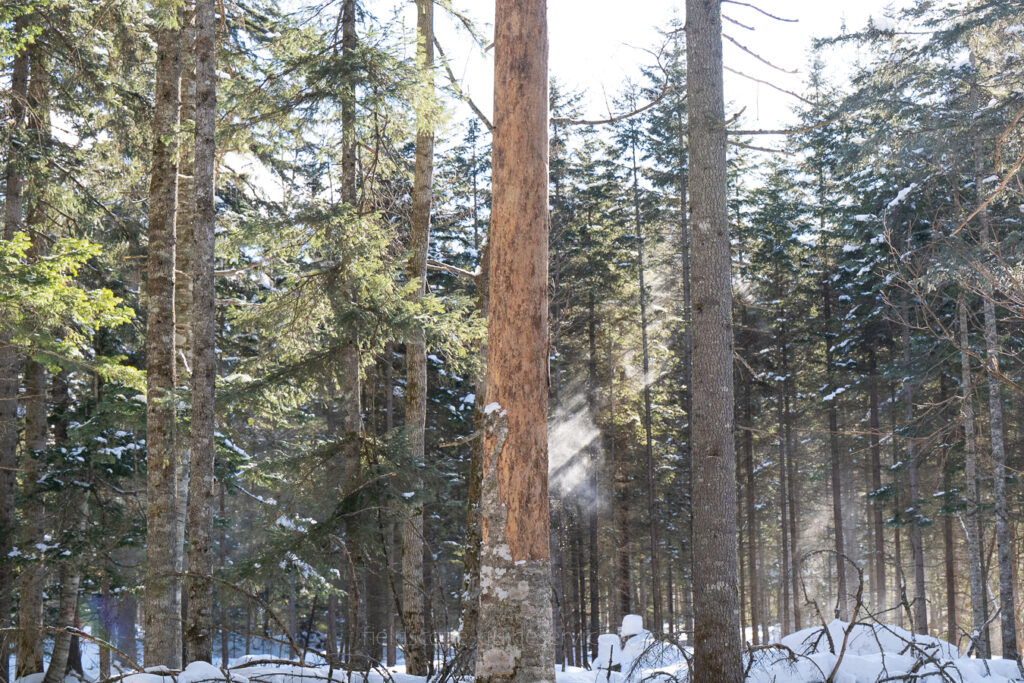
ちょうどカメラを取り出している瞬間だったので、どこかへ飛んでしまったのかと思い。残念、と諦めて100mほど歩いたとき何か引っかかる違和感・・・ハッと気がつき慌ててトド松に戻り、木の周りをぐるっと歩いてみると。
I had been right in the middle of reaching for my camera, so I assumed it had simply flown off somewhere. “Too bad,” I thought, giving up.
I walked on for about another hundred meters when… a strange feeling tugged at me. A subtle sense of “something isn’t right.” I froze. Realizing what it might be, I hurriedly doubled back to that fir tree. I began to circle the trunk, my heart racing just a little, searching for what I might have missed.
それがこのクマゲラとの出会いです。
14:30pm頃で普通じゃないくらい早いねぐら入りでした。これが定刻なのか、それとも今日だけなのか。はたまた緊急避難のように穴に入っただけなのか。
それから何度も通って、ねぐらに使用していることが確定しました。定刻は他のクマゲラに比べると1時間以上早めのマイペース。
これも今季の暖かさによるものかなぁと予想していますが、他に3つあるねぐらのクマゲラ達は日没頃なので、どうなのでしょう。分かりません。
でも、おかげさまでモモンガの出巣の時間に慌てることなく、接続ができます。たくさんのゲストとここで、このオスのクマゲラのねぐら入りを観察することができました。
And that was my first true meeting with this Black Woodpecker.
It was around 2:30 PM—an extraordinarily early time to settle into a roost. Was this his usual schedule, or just a one-time thing? Or perhaps he had tucked himself away as an emergency refuge?
Since then, I’ve returned many times and confirmed that he is indeed using it as his regular roost. His “curfew” is over an hour earlier than other Black Woodpeckers I know; he truly marches to the beat of his own drum.
I suspect this might also be due to this season’s unusual warmth, but since the woodpeckers at the other three roosts I monitor still return around sunset, I can’t say for sure. Nature keeps its secrets.
Still, thanks to his early schedule, I can now guide guests to see him without having to rush off to the flying squirrels’ emergence. I’ve already had the pleasure of observing this male woodpecker’s homecoming with many of my guests.
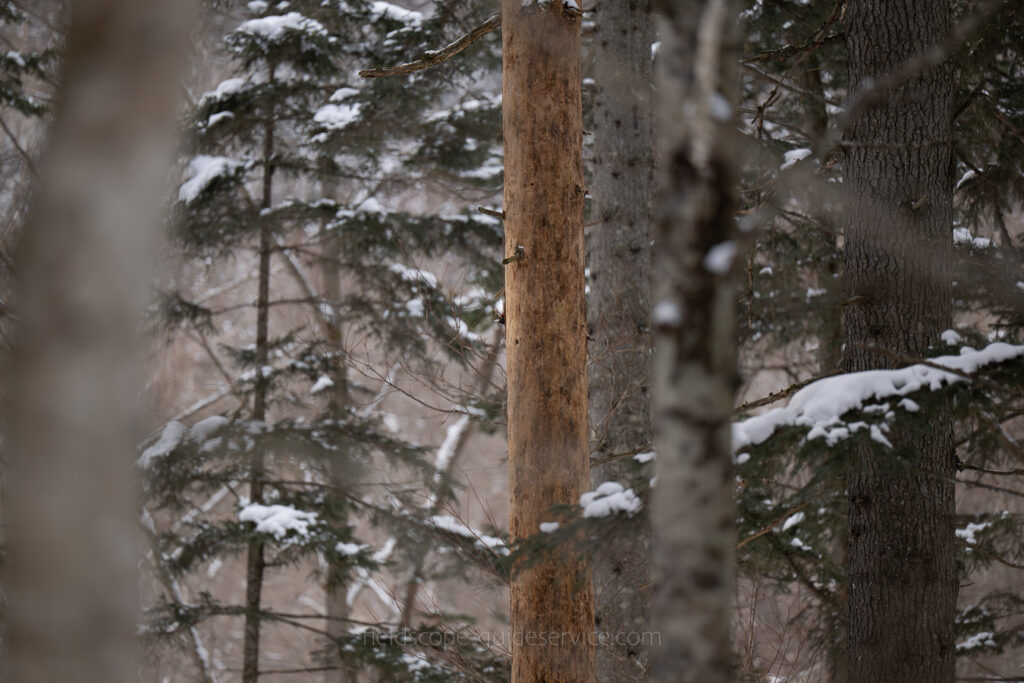
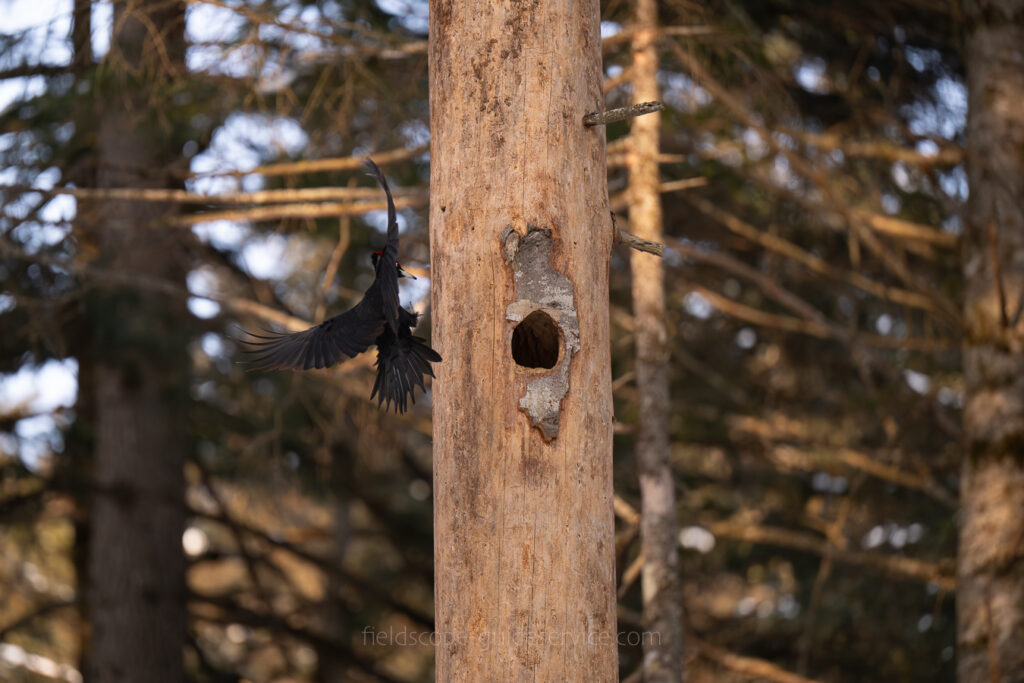
ねぐら入りは何度見てもいいものです。静かに森で待つ時間から始まり、やがてキロキロキロ・・・という鳴き声がどこからか聞こえてきます。森を縫うように飛び、時にはゲストの頭の上を通って3箇所ほど候補のある木に留まります。それからゴツゴツという木を叩く音とケーンケーンという不思議な声。キョロキョロと様子を伺いながら、タイミングを測っているようです。
それが5分以上続くこともあれば、1分のこともありますが、ゲストの横に立ち飛びたちのタイミングを小声で伝えます。キロキロキロ・・・と飛んだ瞬間に、押して!と合図を出して緊張の撮影。クマゲラはねぐら穴の側に留まり、少しすると穴に入っていきます。
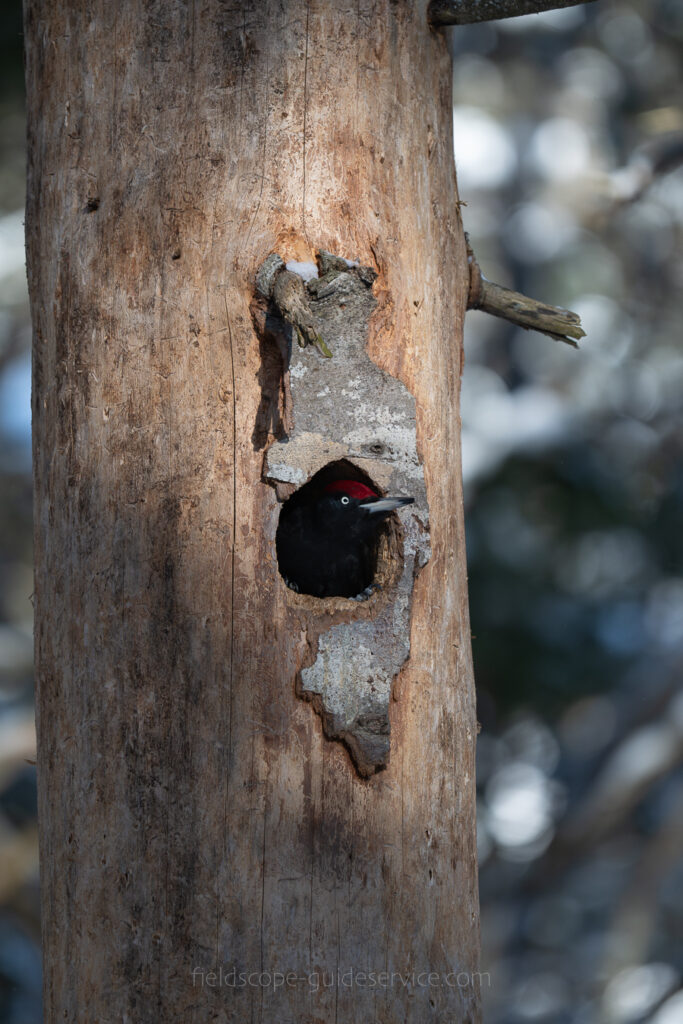
それからお決まりの顔出し。
おかえり!と心の中で挨拶をして、さよならです。
Watching a Black Woodpecker settle into its roost is a ritual that never grows old. It begins with the quiet act of waiting in the stillness of the forest. Then, from somewhere in the distance, you hear it—the sharp, rolling “ki-ki-ki-ki…” call.
He weaves through the trees, sometimes swooping right over the heads of my guests, before landing on one of his three favorite lookout spots. Then comes the rhythmic thump-thump of beak against wood and that mysterious, haunting “kyoon-kyoon.” He looks around restlessly, as if measuring the perfect moment to make his move.
This anticipation can last five minutes or just one. Standing beside my guests, I whisper the timing of his flight. The moment he takes off with another “ki-ki-ki-ki…”, I give the signal: “Now! Press it!” The air fills with the tension of the shutter. He lands right by the entrance, pauses for a heartbeat, and then slips into the hollow.
Finally, there’s the customary “peek-out”—his face appearing briefly at the entrance.
“Welcome home,” I greet him in my heart, and then it’s time for us to say goodbye.
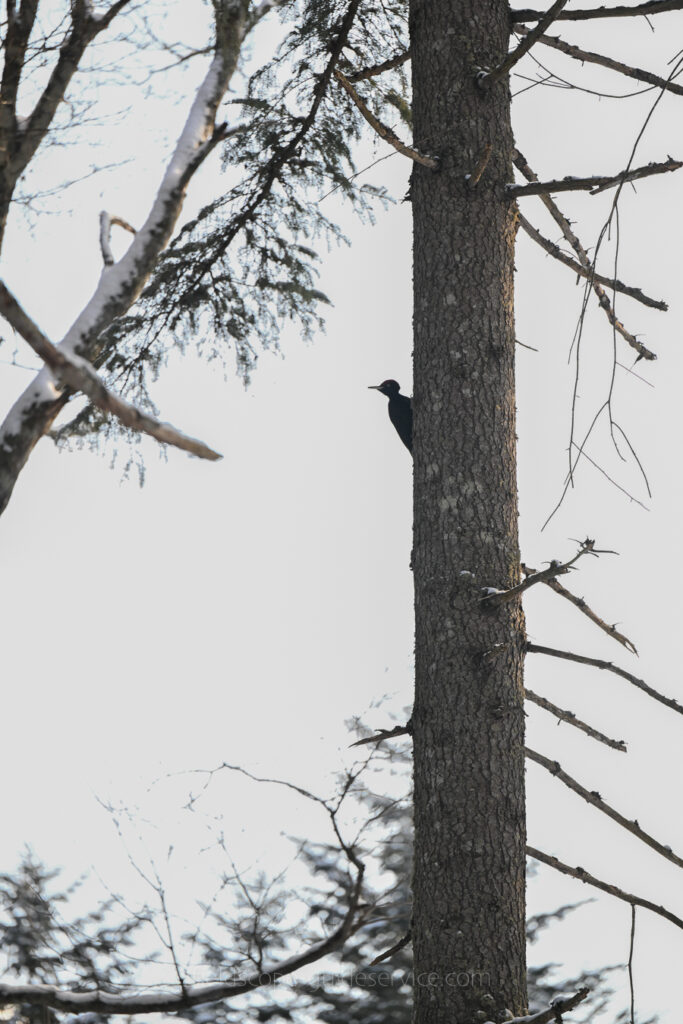
クマゲラショーは始まりから終わりまで、本当に素敵な流れです。
音と動き、少しとぼけたクマゲラの表情まで私は大好きです。
こうして、なんでも無いような1日の地味なリサーチによって、森の秘密が少しずつ分かってきます。もちろんその裏には何倍もの本当になんでも無い日があります。
繰り返し観察を続けていると必ず撮りたい瞬間が出てきます。写真の技術や知識はゲストの方が遥かにあって、経験も豊富なのに、あれもう撮らないの?と思うことがあります。
とても勿体無いことです。
The “Black Woodpecker Show,” from its opening to the final act, is a truly magnificent sequence. I love everything about it—the sounds, the movements, and even the woodpecker’s slightly dazed, comical expression.
It’s through these quiet, unremarkable days of research that the secrets of the forest slowly reveal themselves. Of course, behind every such discovery are countless other days when, truly, nothing happens at all.
If you keep observing, time and again, the “perfect moment” will eventually present itself. Interestingly, I often find that while my guests possess far superior photographic skills and gear, they sometimes stop shooting too soon. “Are you finished already?” I find myself wondering. To me, it feels like such a missed opportunity.
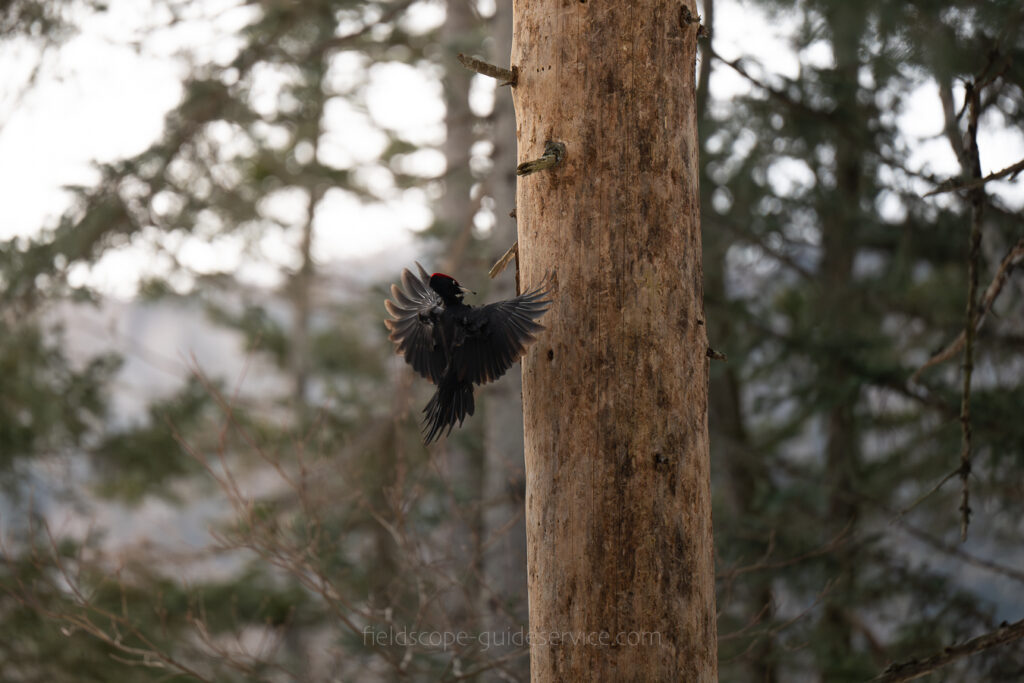
同じように見えても、毎日違うねぐら入り。時間も季節も進みます。
間も無く、冬が終わり子育てのシーズンですね!3月は変化が大きく、不安定。シマエナガもちらほらカップルになり始めているみたい。キタキツネは日中に見かけることが減ってきました。クマゲラは・・・どうなるかな。実はこのオスのクマゲラは昨年は番だったのが、何かがあって別居中。少し心配です。
Even if they look the same on the surface, every “homecoming” is different. Time moves forward, and the seasons follow close behind.
Before we know it, winter will be over, and the nesting season will begin. March is a month of grand shifts and lingering instability. I’ve noticed the Long-tailed Tits (Shima Enaga) have begun to pair up here and there. The Ezo Red Foxes are becoming a rarer sight during the daylight hours. And the Black Woodpecker… I wonder what’s in store for him.
To tell you the truth, this male was part of a pair last year, but something happened, and he’s been living on his own since. I can’t help but feel a little worried for him.